To explore this, we must look at the policy framework, its practical implications, and its deep connection to everyday life and cultural heritage.
Understanding the Three-Language Formula in NEP 2020
The three-language formula in India is not new. It was first introduced in the National Policy on Education 1968 and later reinforced in the National Policy on Education 1986. The core idea: during their schooling years, students should learn three languages—typically the regional language, Hindi, and English (or another modern Indian language in non-Hindi-speaking states).
The National Education Policy 2020 reaffirms this formula but with greater flexibility. It recommends that children learn three languages, ensuring that at least two of them are native to India, while clearly stating that no language will be imposed on any state. This promotes both multilingual education and linguistic choice.
Cognitive and Academic Benefits of Multilingual Education in India
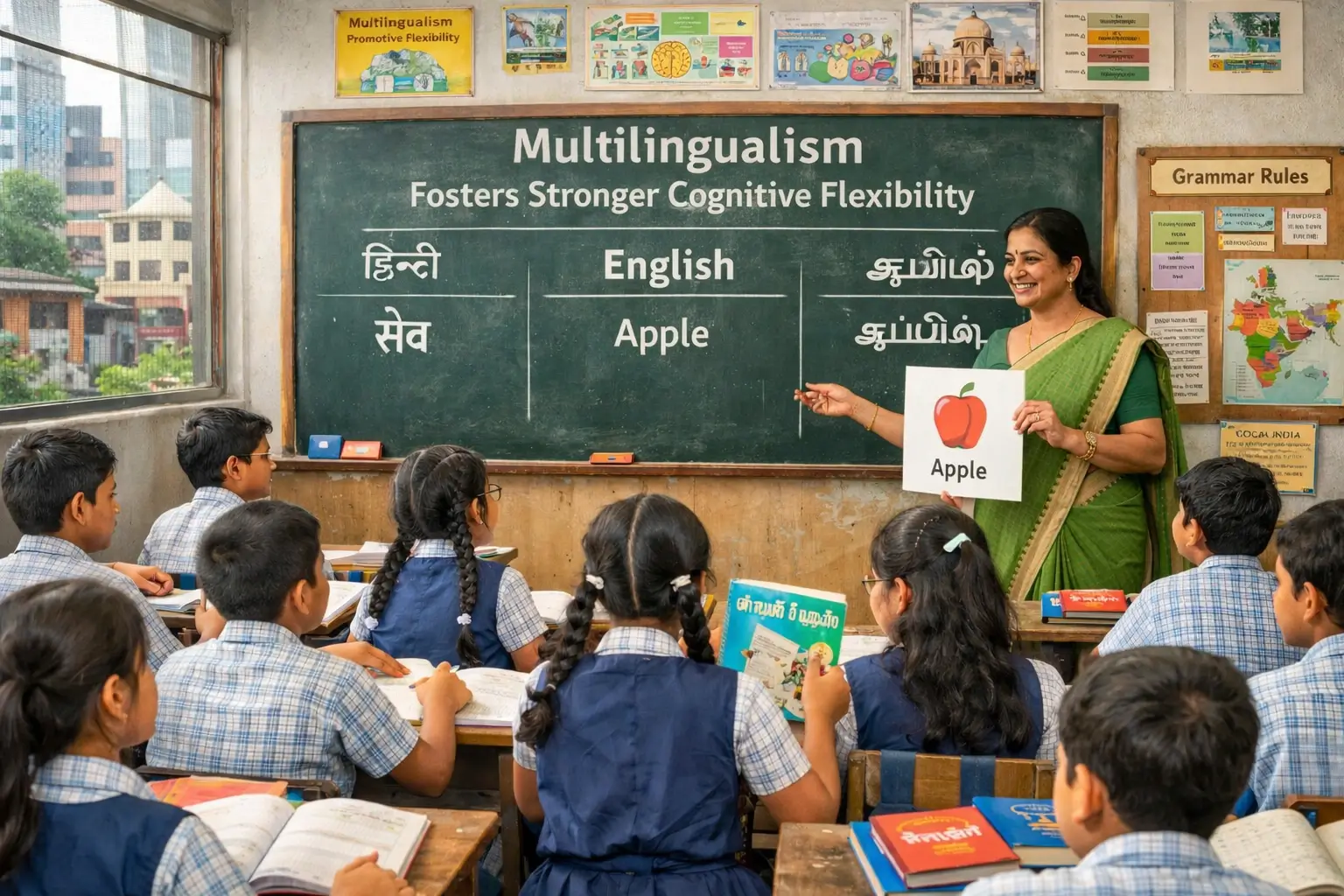
Introducing the three-language formula from Class 6 can significantly support cognitive development. Research in multilingual education suggests that learning multiple languages improves memory, problem-solving, attention control, and mental flexibility.
For students, this means:
Better understanding of complex conceptsEnhanced ability to grasp abstract ideas in science and math.
Improved mental flexibilityEasier switching between different tasks and perspectives.
Stronger adaptabilityEasier transitions to new academic environments across states.
Language learning also supports deeper comprehension across subjects. When students can process information in more than one language, understanding complex ideas in science, mathematics, or social studies often becomes easier.
Alignment with Everyday Multilingual Life in India
Daily life in India is naturally multilingual. A child in Delhi may speak Hindi at home, learn English in school, and hear Punjabi, Urdu, or another regional language in the neighborhood. In cities like Mumbai, Bengaluru, or Hyderabad, many people switch between two or three languages multiple times a day.
The three-language policy in schools reflects this reality. It prepares students to navigate real-life situations more effectively.
Communication
Easily interacting with people from different regions.
Mobility
Traveling and studying seamlessly across diverse states.
Career Edge
Working in jobs that demand strong diverse communication skills.
In a time of rising mobility and migration for education and employment, multilingualism is a practical life skill, not just an academic target.
Strengthening National Integration Through Language
Language plays a central role in shaping identity and unity in India. While diversity is a strength, it can also create communication gaps. The three-language formula is designed as a bridge, promoting mutual understanding among different linguistic communities.
By learning multiple Indian languages, students are more likely to:
- Respect other cultures and traditions
- Reduce regional stereotypes and biases
- Identify themselves as part of a larger national identity
For example, when a student from Tamil Nadu learns Hindi, or a student from Uttar Pradesh becomes familiar with a South Indian language, they gain exposure to different lifestyles and perspectives.

Connecting Students with Cultural Heritage
India’s cultural heritage is preserved and expressed through its many languages. Ancient texts, regional literature, folk songs, proverbs, and traditional knowledge systems are all passed down linguistically.
The three-language formula in NEP 2020 encourages students to stay rooted in their own heritage while exploring others. Learning a regional or mother-tongue language helps children:
Local Traditions
Understand local history, roots, and festivals.
Regional Literature
Read regional stories, poetry, and ancient literature.
Community Wisdom
Connect deeply with elders and knowledge systems.
At the same time, exposure to other Indian languages widens their cultural understanding and appreciation.
Challenges in Implementing the Three-Language Formula from Class 6
Despite its potential, the three-language policy faces real implementation challenges on the ground:
Teacher AvailabilityMany schools, especially in rural areas, lack enough qualified language teachers.
Curriculum LoadStudents already carry a heavy academic load; adding a language requires careful planning.
Regional SensitivitiesLanguage is a political issue. Respecting regional choices and avoiding imposition is crucial.
Infrastructure & ResourcesCreating textbooks and digital tools in multiple languages requires heavy investment.
A Balanced and Flexible Approach for Success
For the three-language formula under NEP 2020 to truly benefit students, implementation must be balanced and flexible. Schools and policymakers should aim to ensure that:
- Language learning is engaging, activity-based, and practical, not rote-driven.
- Students have reasonable choices based on their region and interests.
- Teachers receive proper training and ongoing support.
- Technology and digital tools are used to make language learning interactive and accessible.
The ultimate focus should be on real-life proficiency and usage, not just scoring well in terminal exams.
Long-Term Impact on Students and Society
If implemented thoughtfully from Class 6 onward, the three-language policy in India can help create a generation of students who are:
Linguistically skilled and fluent in multiple languages.
Culturally aware and respectful of diversity.
Professionally competitive in a globalized job market.
In a world where communication and cultural understanding are vital, multilingual individuals hold a clear advantage, while preserving Indian languages helps protect cultural identity.
Three-Language Formula as a Bridge
The three-language formula from Class 6, as envisioned in the National Education Policy 2020, is a forward-looking initiative that aligns with India’s unique linguistic and cultural landscape. When implemented with care, it can enhance cognitive development, support better academic and real-world communication, strengthen national unity, and preserve cultural heritage.